<?xml version="1.0" encoding="utf-8"?><feed xmlns="http://www.w3.org/2005/Atom" ><generator uri="https://jekyllrb.com/" version="4.4.1">Jekyll</generator><link href="https://davidschilling.de/feed.xml" rel="self" type="application/atom+xml" /><link href="https://davidschilling.de/" rel="alternate" type="text/html" /><updated>2026-10-31T12:27:31+00:00</updated><id>https://davidschilling.de/feed.xml</id><title type="html">David Schillings Blog</title><subtitle>Website and blog of David Schilling. Covering technical topics and everything else that interests me.</subtitle><author><name>David Schilling</name></author><entry xml:lang="en"><title type="html">I built a Mac app to keep work and personal links apart</title><link href="https://davidschilling.de/2026/10/21/linklane-work-and-personal-links-on-the-mac.html" rel="alternate" type="text/html" title="I built a Mac app to keep work and personal links apart" /><published>2026-10-21T00:00:00+00:00</published><updated>2026-10-21T00:00:00+00:00</updated><id>https://davidschilling.de/2026/10/21/linklane-work-and-personal-links-on-the-mac</id><content type="html" xml:base="https://davidschilling.de/2026/10/21/linklane-work-and-personal-links-on-the-mac.html"><![CDATA[<p>At work I use Chrome with two profiles: one for work, one for personal stuff. Different logins, different bookmarks, different extensions. That works well until you click a link in another app.</p>

<p>A link from Rocket.Chat opens in whichever Chrome window happened to be in front. A work document lands in my personal profile, where I’m not signed in. A personal link ends up in the work profile. Then I copy the URL, switch windows, paste it, and close the wrong tab. Many times a day.</p>

<p>The problem is that macOS only knows one default browser. It has no idea that Chrome has profiles, let alone which profile a link belongs to. So I built an app that does: <a href="https://linklane.app">LinkLane</a>.</p>

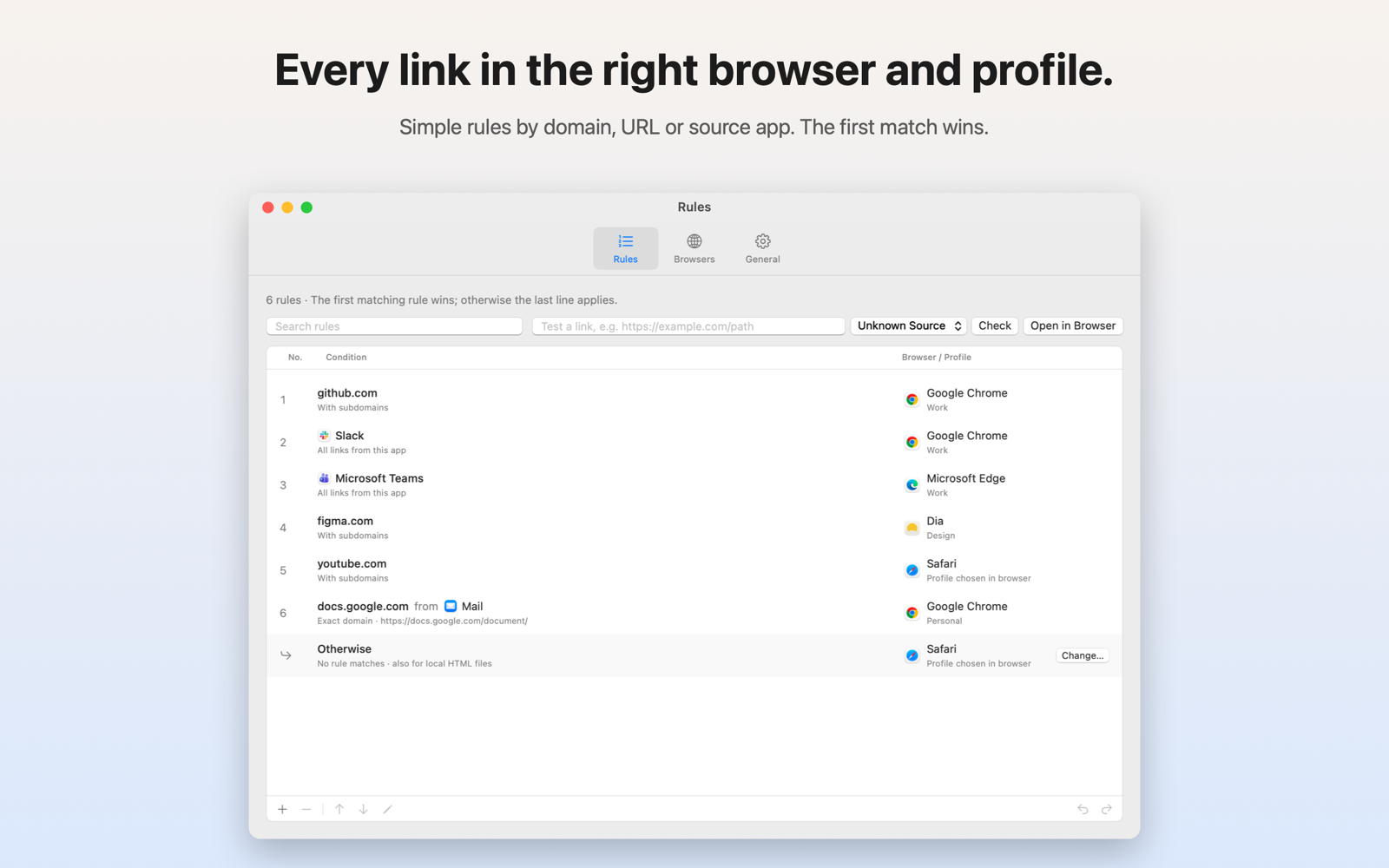
<p><img src="/assets/images/linklane-rules.png" alt="LinkLane's rule list" /></p>

<h2 id="what-linklane-does">What LinkLane does</h2>

<p>You set LinkLane as your default browser once. From then on, every link you click goes through it, and it decides where the link opens. It doesn’t show a window for that. The link simply appears in the right browser and profile.</p>

<p>The decision comes from a short list of rules:</p>

<ul>
  <li><strong>By domain.</strong> <code class="language-plaintext highlighter-rouge">github.com</code> and its subdomains open in Chrome with the work profile. A domain matches exactly or including subdomains, so <code class="language-plaintext highlighter-rouge">notgithub.com</code> never matches <code class="language-plaintext highlighter-rouge">github.com</code>.</li>
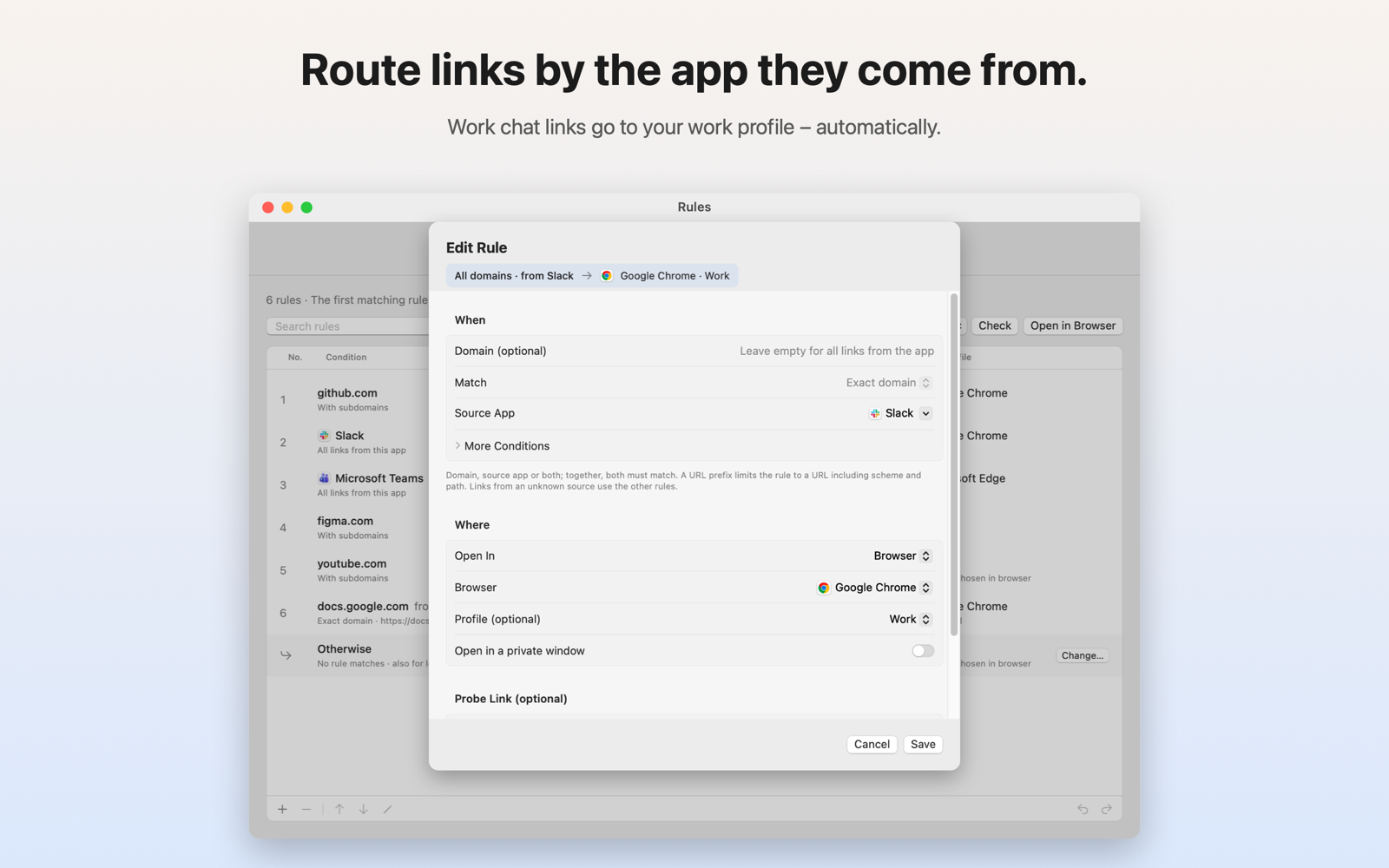
  <li><strong>By source app.</strong> All links from Rocket.Chat or Teams open in the work profile, no matter which domain they point to. This rule turned out to be the one I use most.</li>
  <li><strong>Both together.</strong> Google Docs links from Mail go to the personal profile, Google Docs links from Rocket.Chat to the work profile.</li>
</ul>

<p>The first matching rule wins. If no rule matches, LinkLane opens a default target you choose, or asks you every time.</p>

<p><img src="/assets/images/linklane-source-app.png" alt="Editing a rule: all links from one app open in Chrome with the work profile" /></p>

<p>Sometimes a rule is wrong for one particular link. If you hold fn or Shift while clicking, LinkLane shows a small chooser for this one link and leaves your rules alone.</p>

<p>It works with Chrome, Edge, Brave, Vivaldi, Dia, Firefox and Safari. And because I wanted to know why a link ended up where it did, there is a local history that shows the rule, the source app and the target for every link, and lets you turn any entry into a new rule.</p>

<h2 id="how-it-works">How it works</h2>

<p>A few parts were more interesting to build than I expected.</p>

<p><strong>Knowing where a link came from.</strong> When you click a link, macOS sends the default browser an Apple Event with the URL. That event also tells you which process sent it. Often that is a helper process deep inside an app bundle, so LinkLane walks up to the outermost <code class="language-plaintext highlighter-rouge">.app</code> and compares its bundle ID, never the display name. If the sender is unknown, rules with a source app don’t match, but all other rules still do.</p>

<p><strong>Opening a specific profile.</strong> Chromium browsers accept a <code class="language-plaintext highlighter-rouge">--profile-directory</code> argument with the stable profile folder name, such as <code class="language-plaintext highlighter-rouge">Profile 3</code>. LinkLane stores that ID instead of the display name, so renaming a profile doesn’t break any rules. The URL and the profile are passed as separate arguments, never as a shell command. Firefox gets its profile folder via <code class="language-plaintext highlighter-rouge">--profile</code>, and Dia is controlled through AppleScript, with the URL and profile name passed as Apple Event data instead of being pasted into script text.</p>

<p><strong>The App Store sandbox.</strong> In the sandbox, macOS silently drops launch arguments. The App Store version therefore can’t tell Chrome which profile to use. The solution is a small, separately notarized helper app that only accepts requests from LinkLane’s signature, in one fixed format, without arbitrary options. Without the helper, everything except fixed profiles and private windows works as usual.</p>

<p><strong>Privacy.</strong> LinkLane has no account, no analytics and no server. Rules and history stay on your Mac. Even the optional link cleanup, which removes tracking parameters like <code class="language-plaintext highlighter-rouge">utm_source</code> and unwraps redirect links, runs entirely locally.</p>

<h2 id="try-it">Try it</h2>

<p>LinkLane is available on the <a href="https://apps.apple.com/app/id6821926837">Mac App Store</a> for a one-time price, with no subscription. More details, the free helper and a guide are on <a href="https://linklane.app">linklane.app</a>, and there is a short overview on my <a href="/linklane/">projects page</a>.</p>

<p>If you also juggle browser profiles, I’d like to hear how you use it, and which rule is missing.</p>]]></content><author><name>David Schilling</name></author><summary type="html"><![CDATA[LinkLane sends every link to the right browser and profile – work links to the work profile, personal links to the personal one. Why I built it and how it works.]]></summary><media:thumbnail xmlns:media="http://search.yahoo.com/mrss/" url="https://davidschilling.de/assets/images/linklane-rules.png" /><media:content medium="image" url="https://davidschilling.de/assets/images/linklane-rules.png" xmlns:media="http://search.yahoo.com/mrss/" /></entry><entry xml:lang="en"><title type="html">What’s new on BetterTyping, and how its bots work</title><link href="https://davidschilling.de/2026/10/18/bettertyping-update-and-how-the-bots-work.html" rel="alternate" type="text/html" title="What’s new on BetterTyping, and how its bots work" /><published>2026-10-18T00:00:00+00:00</published><updated>2026-10-18T00:00:00+00:00</updated><id>https://davidschilling.de/2026/10/18/bettertyping-update-and-how-the-bots-work</id><content type="html" xml:base="https://davidschilling.de/2026/10/18/bettertyping-update-and-how-the-bots-work.html"><![CDATA[<p>In January I wrote about <a href="/2026/01/11/reviving-bettertyping-org-with-ai-coding-agents.html">reviving bettertyping.org with AI coding agents</a>. The project didn’t stop there. This post covers what changed since then, and takes a closer look at one part I find interesting: the bots that race you when nobody else is online.</p>

<h2 id="whats-new">What’s new</h2>

<p><strong>More ways to practice.</strong> Besides typing a quote on the homepage, there is now a <a href="https://bettertyping.org/timed-test">timed test</a> (30 seconds, 1 or 2 minutes, optionally with punctuation and numbers) and a <a href="https://bettertyping.org/daily">daily challenge</a> where everyone types the same text and gets ranked against each other. Your profile shows a heatmap of the letters you miss most, and after a few races BetterTyping builds practice texts from your <a href="https://bettertyping.org/learn/weak-keys">weakest keys</a>.</p>

<p><strong>Reasons to come back.</strong> There are daily streaks, with freezes for the days you can’t make it, and optional reminder emails. You can set a WPM goal and see your progress towards it. All of this works without an account. When you sign in later, your streak comes with you.</p>

<p><strong>Sharing.</strong> Every result has its own page with a preview image. You can challenge a friend to beat you on the same text, and there is a WPM badge for your GitHub README.</p>

<p><strong>Signing in without a password.</strong> Next to GitHub, Google and Facebook you can now get a sign-in link by email.</p>

<p><strong>Keyboards.</strong> You can tell BetterTyping which keyboard you are typing on. Each result remembers it, so you can compare your speed across keyboards.</p>

<p><strong>Under the hood.</strong> The project runs on Elixir 1.20 and OTP 29. The biggest change was the multiplayer part: every lobby is now its own process. More on that below. The server also no longer trusts the speed the browser reports. It recomputes it from the text and the time and rejects results that don’t fit the time it measured itself.</p>

<h2 id="how-the-bots-work">How the bots work</h2>

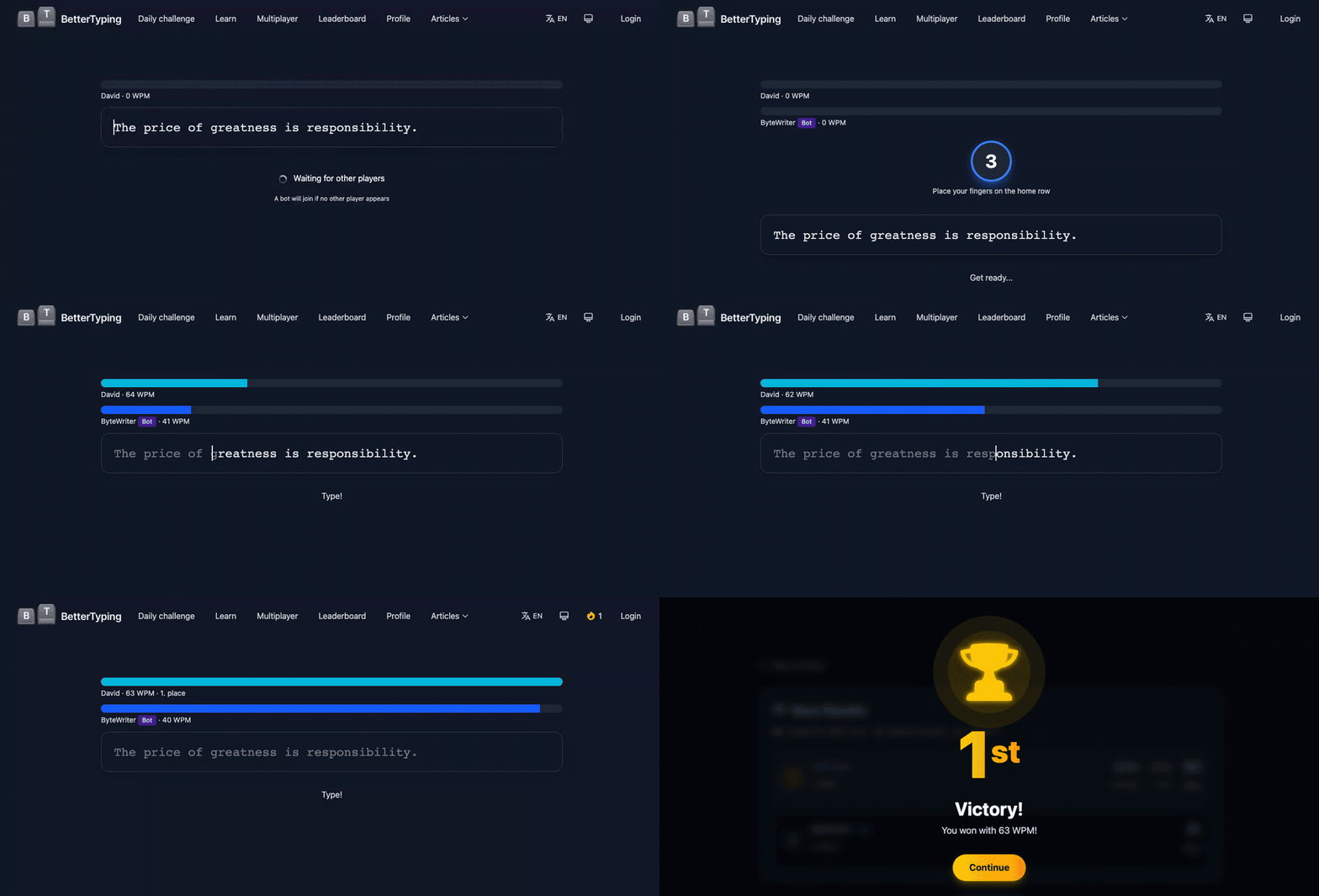
<p>Multiplayer typing has a chicken-and-egg problem. A race is only fun with someone to race against, and on a small site there often is nobody. So if you join a race and nobody else shows up, a bot joins you.</p>

<p><img src="/assets/images/bettertyping-race-against-bot.gif" alt="A race against a bot on BetterTyping" /></p>

<h3 id="when-a-bot-joins">When a bot joins</h3>

<p>When you click “Find online race”, you land in a public lobby. If you are alone, the lobby schedules a bot for 15 seconds later. If a real player joins in the meantime, the timer is cancelled and you race each other instead. As soon as two players are in the lobby, the countdown starts.</p>

<h3 id="how-fast-it-types">How fast it types</h3>

<p>A bot that is much faster or much slower than you is boring. So the bot takes your average speed over your last 100 races as its target. Without any races yet, it types at 40 WPM, which is about the average typing speed.</p>

<p>It doesn’t type at a perfectly constant pace, though. The delay between two characters is derived from the target speed and varies by up to 15% in both directions:</p>

<div class="language-elixir highlighter-rouge"><div class="highlight"><pre class="highlight"><code><span class="k">defp</span> <span class="n">schedule_next_character</span><span class="p">(</span><span class="n">state</span><span class="p">)</span> <span class="k">do</span>
  <span class="c1"># 1 word = 5 characters, so one character takes 60_000 / (WPM * 5) ms</span>
  <span class="n">base_delay</span> <span class="o">=</span> <span class="mi">12_000</span> <span class="o">/</span> <span class="n">state</span><span class="o">.</span><span class="n">target_wpm</span>
  <span class="n">variance</span> <span class="o">=</span> <span class="n">base_delay</span> <span class="o">*</span> <span class="nv">@wpm_variance</span>
  <span class="n">delay</span> <span class="o">=</span> <span class="n">base_delay</span> <span class="o">+</span> <span class="p">(</span><span class="ss">:rand</span><span class="o">.</span><span class="n">uniform</span><span class="p">()</span> <span class="o">*</span> <span class="mi">2</span> <span class="o">-</span> <span class="mi">1</span><span class="p">)</span> <span class="o">*</span> <span class="n">variance</span>

  <span class="no">Process</span><span class="o">.</span><span class="n">send_after</span><span class="p">(</span><span class="n">self</span><span class="p">(),</span> <span class="ss">:type_next_character</span><span class="p">,</span> <span class="n">round</span><span class="p">(</span><span class="n">max</span><span class="p">(</span><span class="n">delay</span><span class="p">,</span> <span class="mi">10</span><span class="p">)))</span>
<span class="k">end</span>
</code></pre></div></div>

<h3 id="a-bot-is-just-another-player">A bot is just another player</h3>

<p>Each bot is a small GenServer. It subscribes to the updates of its lobby, just like the LiveView of a human player. When the race starts, it sends one character at a time to the lobby, through the same path a human player’s progress takes. The lobby doesn’t need to know much about bots: it marks them as such in the UI and counts a bot as finished once it has typed the whole text.</p>

<h3 id="three-bugs-on-the-way">Three bugs on the way</h3>

<p>The bot was the hardest feature of the project so far. Three bugs stand out.</p>

<p><strong>Two bots in one lobby.</strong> In the first version, all lobbies lived in one shared Agent, and a separate scheduler process fired the bot timers. Each timer checked “is there no bot yet?” and then added one. When two timers fired at almost the same time, both checks passed before either bot had joined. The first fix was to claim the timer atomically. With one process per lobby, this kind of bug is gone for good: the timer is a message to the lobby process itself, and the lobby handles its messages one at a time.</p>

<p><strong>Bots that came back.</strong> After a race the bots stopped, and then they were back. GenServers default to <code class="language-plaintext highlighter-rouge">restart: :permanent</code>, which means the supervisor restarts them even when they stop normally. Bots are meant to live for exactly one race, so they are now <code class="language-plaintext highlighter-rouge">restart: :temporary</code>. They also monitor their lobby and stop when it goes away.</p>

<p><strong>A deadlock.</strong> In the new design, the lobby process starts the bot itself. The bot used to join the lobby in its <code class="language-plaintext highlighter-rouge">init/1</code> callback, which calls the lobby. But the lobby was still waiting for <code class="language-plaintext highlighter-rouge">init/1</code> to return, because starting a child blocks until it is initialized. Both processes waited for each other until the call timed out. The fix is to finish <code class="language-plaintext highlighter-rouge">init/1</code> right away and join in <code class="language-plaintext highlighter-rouge">handle_continue/2</code>:</p>

<div class="language-elixir highlighter-rouge"><div class="highlight"><pre class="highlight"><code><span class="k">def</span> <span class="n">init</span><span class="p">(%{</span><span class="ss">lobby_name:</span> <span class="n">lobby_name</span><span class="p">}</span> <span class="o">=</span> <span class="n">args</span><span class="p">)</span> <span class="k">do</span>
  <span class="n">state</span> <span class="o">=</span> <span class="n">new_state</span><span class="p">(</span><span class="n">args</span><span class="p">)</span>
  <span class="c1"># The lobby process may be the one starting this bot,</span>
  <span class="c1"># so calling it from init/1 would deadlock.</span>
  <span class="p">{</span><span class="ss">:ok</span><span class="p">,</span> <span class="n">state</span><span class="p">,</span> <span class="p">{</span><span class="ss">:continue</span><span class="p">,</span> <span class="ss">:join_lobby</span><span class="p">}}</span>
<span class="k">end</span>

<span class="k">def</span> <span class="n">handle_continue</span><span class="p">(</span><span class="ss">:join_lobby</span><span class="p">,</span> <span class="n">state</span><span class="p">)</span> <span class="k">do</span>
  <span class="no">LobbyState</span><span class="o">.</span><span class="n">subscribe</span><span class="p">(</span><span class="n">state</span><span class="o">.</span><span class="n">lobby_name</span><span class="p">)</span>
  <span class="c1"># join the lobby and monitor it</span>
  <span class="o">...</span>
<span class="k">end</span>
</code></pre></div></div>

<h3 id="what-bots-cant-do-yet">What bots can’t do yet</h3>

<p>Bots never make mistakes, and they don’t slow down on hard words the way people do. The next step I’m thinking about is ghost races: racing against a recording of a real run, your own best one or the fastest of the day. That would make the opponent behave like a human, because it was one.</p>

<h2 id="still-built-with-ai-agents">Still built with AI agents</h2>

<p>As in January, AI coding agents wrote most of the code. BetterTyping has become my test bed for these tools: over the year I kept switching between Codex, Claude Code, Cursor and Amp to see how each of them handles a real, existing codebase. My part is deciding what to build, reviewing the result and trying it out. The lobby rewrite above is a good example: I described what was wrong with the old design, and the agent rebuilt it and wrote the tests.</p>

<h2 id="try-it">Try it</h2>

<p>Everything is free and works without an account: <a href="https://bettertyping.org">bettertyping.org</a>. If something feels off, or you have an idea for the bots, I’d like to hear about it.</p>]]></content><author><name>David Schilling</name></author><summary type="html"><![CDATA[In January I wrote about reviving bettertyping.org with AI coding agents. The project didn’t stop there. This post covers what changed since then, and takes a closer look at one part I find interesting: the bots that race you when nobody else is online.]]></summary><media:thumbnail xmlns:media="http://search.yahoo.com/mrss/" url="https://davidschilling.de/assets/images/og-default.png" /><media:content medium="image" url="https://davidschilling.de/assets/images/og-default.png" xmlns:media="http://search.yahoo.com/mrss/" /></entry><entry xml:lang="en"><title type="html">Reviving bettertyping.org with AI Coding Agents</title><link href="https://davidschilling.de/2026/01/11/reviving-bettertyping-org-with-ai-coding-agents.html" rel="alternate" type="text/html" title="Reviving bettertyping.org with AI Coding Agents" /><published>2026-01-11T00:00:00+00:00</published><updated>2026-01-11T00:00:00+00:00</updated><id>https://davidschilling.de/2026/01/11/reviving-bettertyping-org-with-ai-coding-agents</id><content type="html" xml:base="https://davidschilling.de/2026/01/11/reviving-bettertyping-org-with-ai-coding-agents.html"><![CDATA[<p><a href="https://bettertyping.org">bettertyping.org</a> is a typing practice site I built years ago. You can type quotes to measure your speed, and there’s a multiplayer mode where you race others in real time. The entire project is written in Elixir — a language I didn’t know when I started and learned along the way.</p>

<p>Over time, the project stalled. The Elixir version was badly outdated, the frontend was still built with Webpack, and I no longer had a working development setup. I tried once to upgrade everything manually, but between limited time and limited Elixir experience, I failed. From that point on, the codebase was effectively frozen.</p>

<p>Recently, I decided to try again — this time using AI coding agents.</p>

<h2 id="initial-state">Initial state</h2>

<p>Before starting:</p>

<ul>
  <li>Outdated Elixir and Phoenix versions</li>
  <li>Webpack-based frontend</li>
  <li>Broken local setup</li>
  <li>No realistic path to incremental changes</li>
</ul>

<p>In short, I couldn’t confidently run, build, or deploy the project.</p>

<h2 id="tooling">Tooling</h2>

<p>I mainly used <strong>AMP</strong>, and switched to <strong>Cursor</strong> whenever I hit AMP’s usage limits.<br />
AMP uses <strong>Claude Opus 4.5</strong>. The usage allowance is roughly <strong>$10 per day — currently free</strong>, and for the amount of work completed this turned out to be extremely generous.</p>

<h2 id="upgrading-the-elixir-project">Upgrading the Elixir project</h2>

<p>The first task was upgrading the Elixir and Phoenix stack.</p>

<p>This is usually where older Elixir projects die: dependency conflicts, breaking changes, cryptic errors, and a lot of guesswork. I gave AMP a clear description of the project state and asked it to upgrade step by step.</p>

<p>Here are the first two threads that kicked off the revival:</p>

<ol>
  <li><a href="https://ampcode.com/threads/T-019b78df-fed5-7764-b24b-14b4bf82e1ef">The first AMP thread understanding the project</a></li>
  <li><a href="https://ampcode.com/threads/T-019b78e7-63a5-709b-bd99-8a43478ff185">Handoff thread to update the Elixir version</a> — I gave a very simple task: “The project uses an old version of elixir. I want it to be updated to the current elixir version.” After that, it did a really good job, and I just had to tell it to fix a few things along the way.</li>
</ol>

<p>Most of the upgrade worked <strong>one-shot</strong>. When it didn’t, the agent diagnosed failures correctly and proposed concrete fixes. After a small number of iterations, the project compiled and ran again.</p>

<p>At this point, I had something I hadn’t had in years: a working baseline.</p>

<h2 id="frontend-webpack--vite">Frontend: Webpack → Vite</h2>

<p>Next, I replaced Webpack with Vite.</p>

<p>I didn’t want to manually reason through legacy Webpack config, so I let the agent handle the migration. AMP converted the build pipeline, updated asset handling, and integrated everything with Phoenix.</p>

<p>The result built cleanly. I made a few stylistic adjustments afterward, but the hard part — getting off Webpack — was done entirely by the agent.</p>

<h2 id="dockerization-and-deployment">Dockerization and deployment</h2>

<p>With backend and frontend working, I dockerized the project and deployed it to my server.</p>

<p>AMP generated the Docker setup, and with minimal adjustments I was able to deploy a new version of <a href="https://bettertyping.org">bettertyping.org</a> for the first time in a long while.</p>

<p>At this point, the project was alive again.</p>

<h2 id="building-new-features">Building new features</h2>

<p>Once the foundation was stable, I continued using AMP and Cursor to build new features.</p>

<p>Importantly, <strong>the agent did most of the implementation work</strong>. I rarely wrote code myself. My role was mostly to:</p>

<ul>
  <li>describe behavior</li>
  <li>validate results</li>
  <li>decide what to build next</li>
</ul>

<p>New features include:</p>

<ul>
  <li>Dark mode</li>
  <li>Migration from Bootstrap to Tailwind</li>
  <li>A multiplayer bot opponent when no human is available</li>
  <li>A completely new typing <a href="https://bettertyping.org/learn">lesson mode</a>:
    <ul>
      <li>finger usage visualization</li>
      <li>level-based progression</li>
      <li>unlocking letters step by step</li>
    </ul>
  </li>
  <li>Visual cleanup of several neglected pages</li>
</ul>

<h2 id="what-worked-well">What worked well</h2>

<p>A few patterns consistently produced good results:</p>

<ul>
  <li><strong>Planning features in a Markdown file</strong>, then letting the agent implement them step by step</li>
  <li>Keeping <strong>threads small and focused</strong></li>
  <li>Giving the agent access to <strong>all build tools</strong>, so it could diagnose issues itself</li>
  <li>Letting the agent <strong>run tests</strong> for both new and existing code</li>
  <li>Using the <strong>browser extension</strong> so the agent could inspect and debug issues directly in the browser</li>
</ul>

<p>This made the agent far more autonomous than I expected.</p>

<h2 id="what-didnt-work-well">What didn’t work well</h2>

<p>Some pitfalls became obvious:</p>

<ul>
  <li>I once asked the agent to commit changes. After that, <em>every subsequent change in the same thread was also committed</em>. Old prompts persist, so you have to be careful what you ask for early on.</li>
  <li>Implementing the multiplayer bot required the most back-and-forth. This was the hardest problem in the project, and the agent spent a lot of time trying approaches, testing them, failing, and retrying — mostly without my intervention, but with noticeable iteration cost.</li>
</ul>

<h2 id="conclusion">Conclusion</h2>

<p>The agents were better than I expected.</p>

<p>They worked well in an existing, non-trivial codebase. They handled upgrades, refactors, and feature development without needing constant guidance. <strong>Claude Opus 4.5</strong> is a very strong model, and <strong>AMP and Cursor</strong> are effective agentic tools when used with the right workflow.</p>

<p>This didn’t feel like “AI-assisted autocomplete.”<br />
It felt closer to delegating real implementation work — and reviewing the results.</p>

<p>For an old project that was effectively abandoned, that made all the difference.</p>

<p>I am excited to continue improving bettertyping.org with AI coding agents, and I am looking forward to seeing how these tools evolve.</p>]]></content><author><name>David Schilling</name></author><summary type="html"><![CDATA[bettertyping.org is a typing practice site I built years ago. You can type quotes to measure your speed, and there’s a multiplayer mode where you race others in real time. The entire project is written in Elixir — a language I didn’t know when I started and learned along the way.]]></summary><media:thumbnail xmlns:media="http://search.yahoo.com/mrss/" url="https://davidschilling.de/assets/images/og-default.png" /><media:content medium="image" url="https://davidschilling.de/assets/images/og-default.png" xmlns:media="http://search.yahoo.com/mrss/" /></entry><entry xml:lang="en"><title type="html">Hello World</title><link href="https://davidschilling.de/meta/2017/07/15/hello-world.html" rel="alternate" type="text/html" title="Hello World" /><published>2017-07-15T11:06:01+00:00</published><updated>2017-07-15T11:06:01+00:00</updated><id>https://davidschilling.de/meta/2017/07/15/hello-world</id><content type="html" xml:base="https://davidschilling.de/meta/2017/07/15/hello-world.html"><![CDATA[<p>Hello Internet. I’ve always wanted to have a blog. So far, it has probably always failed due to my laziness. But that should be over now. If you’re reading this blog post, I’ve at least managed to write a first post and put it on the internet.</p>

<p>I’m David Schilling and I’m a software developer from Karlsruhe, Germany. I mainly work with Java, PHP, JavaScript, and Android. Sometimes I also venture to the other side and do some server administration work.</p>

<p>These are also the topics I’ll be covering here. It will be about topics I encounter in my daily life as a developer and that I find interesting enough to document.</p>

<p>I’m planning to write one or two articles per month. We’ll see how well that works out.</p>

<p>If you have reactions, responses, or suggestions for improvement regarding any of my posts, just reach out to me on Twitter or send me an email. You can find my contact information in the footer of the page. There are no comments here for now. Maybe that will be added later, but I want to try it this way first.</p>]]></content><author><name>David Schilling</name></author><category term="meta" /><summary type="html"><![CDATA[Hello Internet. I’ve always wanted to have a blog. So far, it has probably always failed due to my laziness. But that should be over now. If you’re reading this blog post, I’ve at least managed to write a first post and put it on the internet.]]></summary><media:thumbnail xmlns:media="http://search.yahoo.com/mrss/" url="https://davidschilling.de/assets/images/og-default.png" /><media:content medium="image" url="https://davidschilling.de/assets/images/og-default.png" xmlns:media="http://search.yahoo.com/mrss/" /></entry></feed>